Posted on April 22, 2026
Learn what it means for a plant to be Native, Non-Native or Invasive! Staff members, Brook and Lexi, lead young people in our Louisiana Conservation Corps program on habitat restoration and invasive species management projects. Thank you Brook and Lexi for sharing insite into your work with native and invasive plant species!
Native, Non-native, and Invasive Plants
Native plant species have developed over thousands of years in specific ecosystems.
Non-native plant species are introduced into new ecosystems, and are generally considered harmless. They may find its own niche or share a niche with a native species and exist there harmoniously.
Invasive plants are non-native species that outcompete the native plants and harm biodiversity. They thrive in the places they are introduced to, overtaking the ecosystem and destroying any sense of balance it once had.
How do plant species migrate?
They can migrate both knowingly and unknowingly.
Knowingly — Non-native species that are considered ornamental or thought to be potentially helpful to an ecosystem may be purposely introduced somewhere, much like Louisiana’s invasive Chinese Tallow trees.
Unknowingly — Seeds and spores on clothing from hikes, larvae in boat crevices, and even animal feces allow for species introduction and migration.
The Problem of the Chinese Tallow Tree
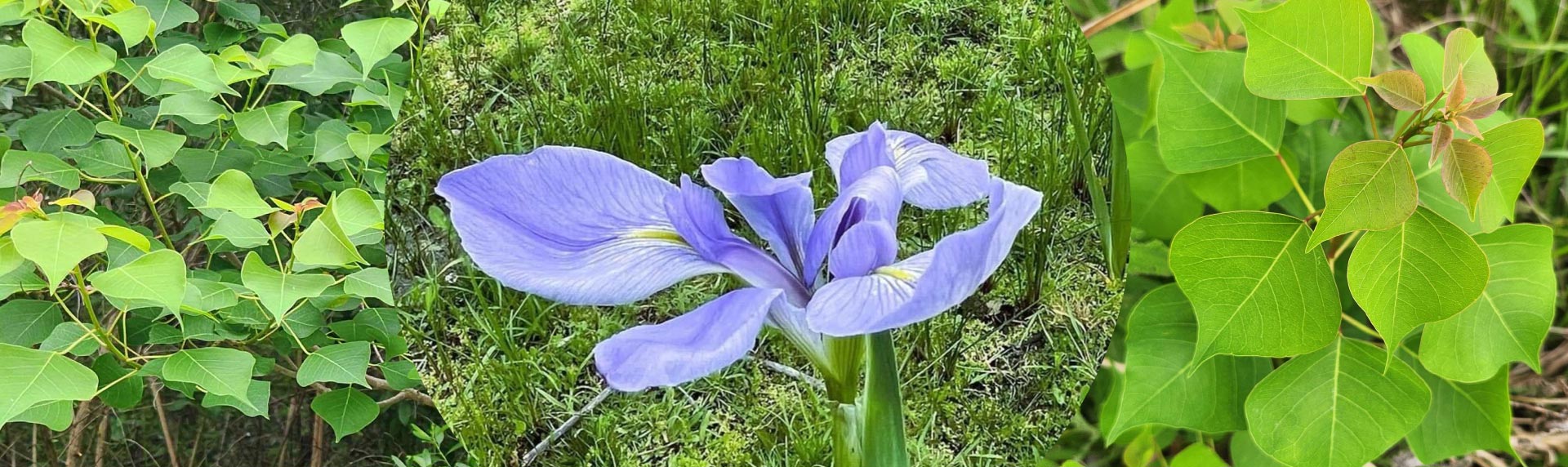
The Chinese Tallow Tree is one of the most harmful invasive plant species we deal with, disrupting the balanced habitat of our Louisiana wetlands.
- Acidifies the soil, lowering the pH making it difficult for native plants to survive
- Blocks sunlight to the understory, reducing photosynthesis of native plants and outcompeting food sources for migratory birds and insects
- Reduces the habitat’s ability to absorb stormwater, increasing flooding and storm damage
- Withstands the ecosystem’s necessary prescribed burns, further displacing native plants
- Grows very quickly — from seedling to 6 feet tall in a year — and almost year round in our climate
- Creats a lot of seeds that birds and many other animals — like squirrels, raccoons, and possums — eat and spread
- Has no natural predators in Louisiana, like insects, mammals, and diseases
What We’re Doing & the Louisiana Iris
At the Northlake Nature Center, we remove adult Chinese Tallow Trees from the bog, opening up the floor of the forest to more sunlight and allowing for more nutrients and growth for native species — including the Louisiana Iris.
Irises are native to Louisiana wetlands — like swamps, marshes, and bayous — and support biodiversity during the spring migratory season. They tend to bloom in clumps in a field all at the same time and attract hummingbirds, butterflies, bees, and small insect pollinators. Birds traveling from Mexico and South America to northern locations will rest here for shelter and food. These migratory rest stops and the food available are essential for migratory birds to make it to their final location.
The Grand Isle is also along this migratory path, and another great location for these irises. Partnering with The Nature Conservancy, we’ve transplanted irises from the Grouletta trail to other locations on the Grand Isle.
Are Chinese Tallow Trees all that bad?
No! There are many benefits to the Chinese Tallow Tree in its native environment in East Asia, where it’s been cultivated for many centuries. The problem, like with any species, happens when it’s introduced to a new ecosystem and reduces biodiversity.
Who We Are
The Louisiana Conservation Corps program of American YouthWorks prepares young people, ages 16-35, for careers in environmental conservation and disaster response.
Through paid training, participants impact our country’s urban and rural communities, from local green spaces to National Parks, by completing projects in habitat restoration, disaster response, wildfire mitigation, and conservation and forestry. Serving outdoors together, participants find a sense of adventure, purpose, leadership, community and belonging.
Conservation Corps Program
More Stories & Events!
Posted on March 23, 2026
Mahnoor, a graduating crew leader on our Texas Conservation Corps (TXCC) program’s Conservation and Disaster Response crew, completed the Women’s Tree Climbing Workshop (WTCW) after hearing about the opportunity through our City of Austin partnership. Congratulations on completing the workshop
Read on
Posted on May 6, 2026
“I walked away with certifications in OSHA, NCCER, Solar Installation, and Pre-Apprentice Electrical Training, plus valuable skills in solar panel installation and home framing. The highlight for me was the people, working alongside a great team and learning how to
Read on
Posted on April 20, 2023
The Clean & Green program’s commitment is to foster an environment of mutual respect and trust among all participants while servicing the larger community. The following comments are samples of participants voluntary feedback shared with staff on what the Clean
Read on
Sarah V. - txcc
When I joined the GulfCorps crew with Texas Conservation Corps (TXCC), I had recently completed undergraduate degrees in Environmental Biology and English, but I didn’t have a specific career direction in mind. I knew that I loved environmental sustainability and I had always been successful in school, however, job searching proved frustrating. When I stumbled across TXCC’s job posting, it sounded like a perfect way to get some experience. The idea of spending so much time in the field restoring coastal prairie habitat was exciting to me, so I applied, hoping I’d be accepted. Even though I couldn’t wait to start my term, I still wasn’t ready for just how incredible the experience was. During my 6-month term I built skills that are crucial for a career in conservation. I learned how to use power tools and hand tools safely and effectively, as well as maintain tools. I pushed myself beyond what I thought I was capable of to pass a pack test and earn a certification in wildland firefighting. I cultivated skills in GIS/GPS technology. I learned how to step back when something inevitably went wrong and problem-solve successfully.
However, these useful hard skills pale in comparison with everything else I gained from my time at TXCC. Every day, I got to work with the most amazing team. My crew made me laugh, inspired me to do better, and altered my perspective on the world. With my crew’s support, my reserved nature gave way to confidence. Although I’d always considered myself a follower, I discovered that I had leadership qualities. I felt at home while I was part of this team, and the relationships I built with members, leaders, staff, and project partners will always be meaningful to me.
I finished my term only a few weeks ago. I wish my term had been longer than 6 months, but I’m excited about the future. Before joining the GulfCorps crew, I had been considering working as an environmental consultant—one of the most lucrative jobs in the environmental field. After this experience, I have different priorities. I know that the skills I gained have prepared me well for a career in conservation, and I hope to find a position where I can continue to learn about ecology while making an impact. Finding my exact career path will continue to be an adventure, but now I feel that I have purpose thanks to the trainings and experiences I had at TXCC.
×
Michael L. - txcc
With no sense of direction post-college, having just received a Degree in Biology which I wasn’t sure “how to use”, I decided to accept a Crew Member position on a Coastal Restoration Crew based in Houston. During my entire term, Texas Conservation Corps (TXCC) provided the guidance I needed to set a course for the rest of my life: from learning about the skills and culture of conservation work, to everything that comes with transplanting to a new city.
While serving a term as a Crew Member in Houston; then leading a crew in Austin – there was never a day I dreaded going to work. Through TXCC I met an incredibly diverse group of thoughtful, thought-provoking people all connected by a compulsion to serve and have fun doing it. I learned how much of an impact working outdoors with my hands had on my mental health — now a critical criterion for any job I apply to. I also learned and practiced a plethora of hard and soft skills, thanks to the support but also freedom and agency afforded by the staff, which is something I’ve found unique to TXCC. But maybe the most important thing was the self-efficacy I gained from overcoming the many types of challenges presented by crew life inside a safe, open-minded, and accepting community.
Following TXCC — and thanks to it — I gained a position as a wildland firefighter on an engine crew with the Oregon Department of Forestry. I’m now working for the Forest Service on the Mark Twain National Forest performing prescribed burns and initial attack, and even have a job lined up for next fire season with the Bureau of Land Management in California. TXCC revealed a career path I never imagined for myself, but it’s everything I was looking for.
×
Jeff D. - txcc
Joining Texas Conservation Corps (TXCC) was seriously one of the best decisions of my life. Before TXCC, I was going to school with no real direction or interests and doing jobs that I really didn’t enjoy. I was sort of just going through the motions.
During my time in Texas, I would like to say that I grew a ton. In only 6 months, I found a group of people that I can call my friends for the rest of my life. None of us had a clue what we were doing in the beginning. No trail experience, no chainsaw experience, and certainly not the teamwork experience that you can only gain by working in such a close crew. In the end, we’d all grown.
However, a term with TXCC is no easy task. Days consisted of working in the hot sun, eating cold leftovers for lunch, and doing tool maintenance when it was all said and done. It is all worth it though. The bond you build with those that you work with and the difference that you can visibly see are priceless. Some of the most physically and mentally exhausting days were also the best and I wouldn’t give them up for anything. Everybody at TXCC is filled with passion for what they are doing and it is infectious.
I am now going to school and am pursuing a degree in environmental science. I hope to use the work experience that I gained while in Texas to help me secure a job doing what I love most, working outside.
×
Willard S. - youthbuild
My name is Willard, a nationally recognized AmeriCorps member. Before I was introduced to YouthBuild Austin, I was uncertain of my future, confused, and lost in life. I just got out of doing 18 months in jail and I had no education, I was unemployed, and I was clueless.
Before I was evicted from my last place, I lived down the street from American YouthWorks. Every time I rode the bus I was curious about the place I passed. After I was denied at Job Corps, I decided to see what American YouthWorks was all about.
I started planning on getting my GED. After I failed the first GED test, I felt discouraged and wanted to quit school again but the staff came up with another plan. I was informed I could try and take my TAKS tests over the summer and if I did well there might be a possibility of me being able to get my diploma. So I stuck it out and passed all four TAKS tests and enrolled into the diploma program.
I also participated in the Media Corps program. We learned how to refurbish computers that we donated to low-income families. Along with that we learned how to use Adobe Illustrator, Photoshop, and Premiere Pro and earned certifications. We learned graphic design, screen-printing and wood engraving, filming, video editing, and so on…
Mind you, I began trying to get my GED and I finished with a high school diploma. I just walked the stage at graduation with my whole family and little girl watching thanks to the amazing staff at YouthBuild Austin. Now I plan to get a job with the City of Austin. I have my second interview next week! That’s not all…I already have a plan to get my CDL and go to college for music.
×
Mario C. - youthbuild
As a child I was born into a family that was just starting to fall apart, I lost my father at a very young age, and my mom was a hard working individual so she was never really around. She made sure we had food on the table, and a roof over our head. The loss of my father really affected me growing up, I felt as if I had no role model or no one there to teach me right from wrong so I taught myself.
Growing up, I did a lot of things normal kids wouldn’t do. I would roam the streets to find some kind of excitement, which normally lead to trouble. I found myself in the wrong crowd, with the wrong influences. I was always the smart one out the bunch, I always thought twice about what I did or what I was about to do, and that technique stayed with me until this day. Without this technique, I honestly don’t know where I’d be. As I got older, I started to figure out that I was on the earth alone, and it was up to me to define my life. I started to act the way a normal kid should, go to school, come home, do homework, and play games. Anything that kept me occupied was a good thing. It kept my mind off the negativity. I had straight A’s and B’s throughout my elementary and middle school years, but when I got to the 8th grade my troubles caught back up to me. I ran into the crowd I was avoiding all those years, and there were way more problems from when I was a kid. I got involved with the laws, and into a whole bunch of fights that I thought would eventually lead to prison or maybe even death. As I started to fall apart, my grades dropped as well as my attendance, and I felt that school wasn’t for me anymore. When I became a freshman, I didn’t even attend school, but I created my son, which would change my life forever.
I slowly changed my life around…. my grades went up, and my attendance got better but it wasn’t enough come my senior year. I didn’t have enough credits to graduate. I was becoming an adult, which meant I had adult priorities that I couldn’t really fulfill, and I lost hope in myself! I felt as if I was letting my family down. That summer I ran into a friend that told me about a school that could help me graduate and would pay me as long as I attended school. I seriously considered it because I had bills to pay and I needed that diploma if I wanted to be something in life. I attended American YouthWorks and joined a program called YouthBuild that built houses for low-income families. It really taught me a lot and changed the way I looked at the world. I met a lot of people that made me feel like I wasn’t on this earth alone and that I could be something in life for my family. I became a welder and really started to get ahead of the game, but I still wasn’t a graduate and that was the goal I was trying to accomplish even with the thousands of roadblocks I faced. I never gave up hope! Going to ACC to learn welding motivated me even more because I knew if I didn’t graduate, I was never really going to move up in the welding industry and that was money I was losing to provide for my family.
I finally finished my assignments that I needed to get my credits to graduate, and that was the greatest relief I had ever felt. I knew then that I was on the road to success and I can be anything I want to be if I put my mind to it. I honestly think my Dad was next to me the whole time, not in sight but in spirit pushing me to do right even when I was doing wrong. Now I’m graduating and I couldn’t feel more proud of myself.
×
Janice A. - youthbuild
I would like to start off this story by introducing myself. My name is Janice. I was born and raised in New Orleans, Louisiana. I came to Austin, Texas in 2005 after a Hurricane Katrina. I was only 14 years old at the time and this was my very first time coming to a new city, leaving my hometown that we called “The Boot.”
In Austin, I was targeted by middle school girls for being a “tom boy.” The school placed me into a program for students that were refugees from New Orleans. This program made us all stand out and we were targeted even more. I started getting into fights, I was even stabbed. This caused me so much damage to the point my grades started to drop. I stuck through it and it took many years to finish all my credits in school, but I could never pass the TAKS test. I tried so many times, but eventually gave up. I got in some legal trouble, because of a so called “friend,” but it made me realize something. That evening I came and sat down, looked at my daughter, and at that moment I told myself I’ll do better by her because she needs someone to protect her and guide her through life.
The next day my friend asked me to come to American YouthWorks with her so she could join the program. I found out that I could join too and work on my TAKS even though I was over 21. American YouthWorks took me in with open arms and opened my mind, not to mention so many doors because of all my accomplishments since I’ve been here.
I have learned so much in the Media Corps Program. Mr. Matt is brilliant teacher, so down to earth, and the other teacher, Ms. Kim, is so sweet. They help students such as myself learn computers skills. These computers are fixed up and donated to families in need. The step that excited me the most, I must admit, was being able to donate the computers back into my community. This made me proud of my work, knowing it would be useful and helping someone else, giving them an opportunity too. In Media Corps, we volunteer as much as possible. This way my classmates and I have the opportunity to have hands on experience to help people in our community and elsewhere in Austin.
My journey was not easy and I kept taking the TAKS test and failing by a few points. My childcare was denied four times for no reason while in the program. I felt like giving up at times, but YouthBuild would not give up on me. This school, I now call home. It is a family that looks for courage and dedication in people, to help them see their potential and give them will power to wake up every day, to be on time, and try your hardest. They saw something in me that with their help, I started to see too.
This school helped me clear my background, get childcare back, gave me training, and amongst other things, they got me ready to be successful. I am now able to see a difference in my life and in my children’s lives. Finally, in June I received my diploma and was able to walk the stage in my cap and gown. I participated in the Community Health Worker’s Certification Program and now I am enrolled in Austin Community College’s CNA (Certified Nurse Aide) Program for January 2017.
I have not one but two education awards to use toward college. This program helped me through it all. I was given resources I didn’t know existed. They cheered me on throughout my journey and still to this day, because like we say here, “Once YouthBuild, always YouthBuild!!
×
Lisa P. - txcc
When I first joined TXCC as a crew leader, I only had five months of trail work under my belt, a college degree in a field that no longer interested me, and my only leadership experience came from managing fellow students part-time at my university’s dining hall. I was saddled with student loans, lacking in many real-life skills, and without purpose or career goals.
I grew immensely from my time in Texas, and around the country. First, it came with my own crew leader training: classroom and field-based education on trails, chainsaw use and maintenance, herbicide application, Wilderness First Aid and CPR, local ecology, and leadership skills. Since working with other conservation corps and federal agencies, I’ve gotten to appreciate how thorough those trainings were, even with the limited funding a small, non-profit has at its disposal. The chainsaw trainings put on by the TXCC staff, for example, were as good, if not better, than any official certification I’ve received since then. I still feel confident in my abilities, not only in completing these kinds of tasks myself, but in teaching others, and in understanding the reasons behind the methods. TXCC’s emphasis on teaching the whole picture for each and every project gave me more ownership and pride in what I did, and gave me the knowledge to be able to assess and plan for situations I encountered in the future.
I had the challenging and powerful experience of responding to several disasters across the country as an Emergency Response Team leader. At times it was heartbreaking: seeing the immense destruction first hand, and speaking with people who had lost their homes, belongings, or loved ones. At other times, it was beautiful and awe-inspiring: meeting some of the most selfless volunteers, and genuinely incredible human beings, that I’ve ever had the honor to know, and witnessing communities who had lost so much come together to help each other rebuild their lives. I tell people now that disaster relief showed me some of the best and worst aspects of humanity. It was also an indescribably stressful, fast-paced, and complex work environment that I previously had known nothing about. Having that kind of responsibility – knowing my actions affected individuals and whole communities in such an immediate way – was terrifying, empowering, and ultimately some of the most meaningful experiences of my life.
But the learning process never stopped throughout my time with TXCC. The value placed on jobs training and education of its members truly shows. I was constantly improving or learning new skills, and was encouraged by the staff to spend time on such opportunities for my crew members as well. I left TXCC to spend two years with the U.S. Forest Service as a professional trail worker. When I looked back, I had an immense appreciation for the amount of training and work we accomplished at TXCC with a much smaller budget. I loved the feeling of being on such a hard-working crew, and longed to get back to that enthusiastic, motivated, inspiring atmosphere.
I’ve now found my way back to the conservation corps world, securing a position as a Crew Supervisor with the Washington Conservation Corps, whom I’d had the opportunity to work with as a TXCC Crew Lead after Hurricane Sandy. I feel lucky to be back in an environment of growth and opportunity, of helping young people lacking in purpose or confidence or real-life skills realize how strong they are, the strong social bonds they can create, and how important it is to give back to our local communities and natural spaces. I believe whole-heartedly that the TXCC model changes people’s lives and the communities they live in, and encourages young people to stay engaged and active in their local society wherever they may end up next. The importance of service, of believing in one’s power to make big differences by starting small, of bringing positivity and hope into the forefront of every obstacle one tackles, is such a unique and important lesson, especially when it’s so much easier to be jaded and indifferent. I know I have often fallen victim to apathy when confronted with challenges that seemed too big to overcome, as have many other young people I know. The TXCC program taught me to choose action over apathy, enthusiasm over pessimism, and showed me how infectious that mentality can be to those around you. I bring those lessons with me every day to my new crew members in Washington.
I ended my service with the Texas Conservation Corps much stronger physically and mentally, with a wealth of marketable skills and friendships, debt-free, and more committed to being an active, engaged citizen. I truly am a better person, personally and professionally, because of TXCC.
×
Colleen Z. - txcc
My time with the Texas Conservation Corps (TXCC) provided invaluable experience toward my career today. Prior to being on a Trails Across Texas (TAT) crew I had been working at restaurants and in office positions in Maryland. I was financially stable, but unsatisfied and worried about what the future would hold career-wise. It was time for a change.
Several of my friends from college were living all over the United States serving as AmeriCorps members at the time. I often saw their adventures posted on social media and decided I wanted to give it a shot. I found TXCC on the AmeriCorps website and applied for a crew member position on a TAT crew.
Working in the Texas heat for long periods of time was no easy task, but it made me feel validated that I had earned a degree in environmental studies and I was finally doing something I believed in. TXCC is the reason I chose to ultimately join the non-profit sector and continue working toward bettering the environment.
After my time with TXCC, I became an AmeriCorps VISTA at Texas Rural Water Foundation the following year. Upon completion of my second year of service, I got a job working with the American Honey Bee Protection Agency. Now my job consists of visiting schools in the Austin area to educate children about bees.
My current path is one that I never thought possible three years ago and I am forever grateful for the experience I gained from TXCC. In addition to the incredible experience, many of the people I worked with are now friends for life.
×